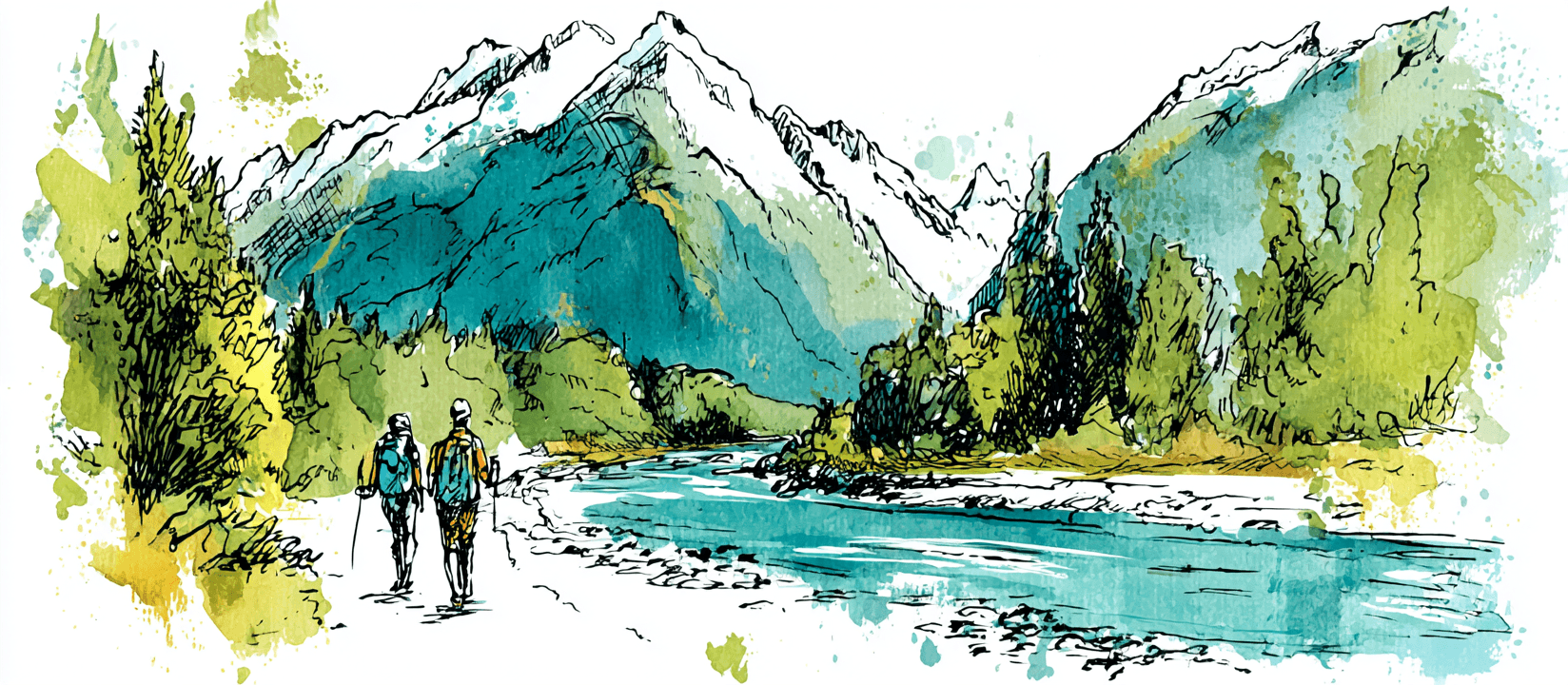
Hollyford Track
Mountains to the sea through the heart of Fiordland
- Trip style
- Build your own route
- Booking season
- Year-round
- Length
- 56 km one way
- Duration
- 4–8 days
- High point
- Low: valley track, no alpine pass
- Direction
- One way (Road End to Martins Bay)
- Permit
- Hut bookings required (DOC)
Track booked out?

You choose your own route and length, booking a spot for each night you need — mix the huts and campsites that fit your plan.
Live availability
Many dates availableMost dates have room right now. Checked in the last hour.
About the track
The Hollyford is Fiordland's great low-level tramp: 56 kilometres down the Hollyford Valley from the end of the Lower Hollyford Road to the open coast at Martins Bay. Unlike its alpine neighbours, the Milford and the Routeburn, it never climbs to a pass. Instead it follows the river through tall beech and podocarp forest, along the shore of Lake McKerrow, and out to the seals, penguins and pounding surf of the Tasman coast.
That low altitude is the point. The track is walked one way, from the Road End to Martins Bay, and most people fly out from the airstrip at the coast or take a jet boat across Lake McKerrow to shorten the return. It is a four to eight day trip depending on how far you go and how you come back, which is exactly why how many nights you book matters: your trip is only as good as the run of huts you can string together on consecutive nights.
Permits and the booking situation
The Hollyford huts are bookable through DOC year-round, and unlike a Great Walk there is no fixed itinerary: you choose how many nights to spend and which huts to stay in, walking them in order down the valley. A classic trip is three to four nights, staying at Hidden Falls, Lake Alabaster (or Mckerrow Island across the lake), Demon Trail, Hokuri and Martins Bay as you go.
The huts are larger than the Great Walk huts and rarely sell out completely, but the popular nights still fill: summer weekends, the settled spells in February and March, and the front-of-valley huts at Hidden Falls and Lake Alabaster that every trip passes through. Line that up with a booked jet boat or flight out and a single missing night can hold up a whole trip.
Here's the thing though: plans change constantly. Groups shrink, weather turns, transport falls through, and bunks trickle back into the system. Because the Hollyford is flexible, a freed bunk at the right hut on the right night can quietly reopen the trip you wanted.
If the nights you need are booked out, it's worth watching. That's what Spotbagger does: we check the DOC booking page often and alert you the moment a run of huts opens up for the number of nights you want to walk, with room for your whole party, so you can grab it before anyone else sees it.
Seasons and conditions
The Hollyford can be walked all year, and the huts book year-round, but this is still serious Fiordland country. It is one of the wettest places in New Zealand: the river and its side creeks rise fast and hard, and several crossings and low sections can become impassable in heavy rain. The Demon Trail, along the rough eastern shore of Lake McKerrow, is slow, root-bound and tiring in any weather.
Summer (December to March) brings the longest days, the busiest huts, and the best chance of settled weather for the coast. Autumn is quieter and crisp but the days shorten quickly. Winter and early spring are cold, very wet, and the transport operators run reduced or no services, so check before you commit. Sandflies are relentless year-round, especially at the lake and coastal huts; bring serious repellent.
Huts
There are six bookable huts down the valley, in order from the Road End: Hidden Falls Hut, an easy first day in; Lake Alabaster Hut at the head of the lake, with Mckerrow Island Hut as an alternative across the water; Demon Trail Hut and Hokuri Hut along the rough lake shore; and Martins Bay Hut out at the coast near the seal colony and Long Reef. Each has bunks with mattresses, a water supply and a toilet, but no cookers, no power and no shops, so carry a stove and all your food.
Your bunks are part of your booking, and which huts you stay in depends on how many nights you take and where your transport meets you. There are no campsites on the standard booking, so the huts are the way the track is walked.
Gear essentials
The Hollyford tests you with water and distance rather than altitude. The short list:
- Rain jacket: a proper hard-shell, fully waterproof, for days of Fiordland rain
- Waterproof boots: broken in, with good tread for mud, roots and the Demon Trail
- Stove and fuel: the huts have no cookers; you carry your own
- Sleeping bag: the huts have mattresses but no bedding
- Insect repellent: serious sandfly defence at the lake and coast
- Dry bags: keep your sleeping bag and spare layers dry when the creeks are up
DOC publish a full gear list and current track and river conditions; read both before you finalise your pack.
Getting there
The track starts at the end of the Lower Hollyford Road, a long drive off the Milford Road (State Highway 94) roughly between Te Anau and Milford Sound. Because the Hollyford finishes a long way from where you start, at the remote coast, transport is the heart of planning the trip.
Most walkers fly out from the Martins Bay airstrip back to the Road End or Queenstown, or take a jet boat across Lake McKerrow to cut out the Demon Trail. A few walk back the way they came. Book your flight or jet boat as soon as your huts are confirmed: the operators run limited schedules, fill up in peak season, and weather can delay coastal flights for days.
Common questions
Do I have to book the Hollyford huts?
Yes. The huts are bookable through DOC and you need a confirmed booking for each night. Bookings run year-round, and you choose how many nights you spend on the track.
The huts I want are booked out. Can I still get a spot?
Often, yes. The huts rarely sell out entirely, and bunks trickle back as plans change. Set up a watch with the number of nights you want to walk and we'll alert you the moment a run of huts opens on consecutive nights with room for your party.
How many nights should I book?
Most trips take three to four nights one way, but the Hollyford is flexible: an out-and-back to Hidden Falls and Lake Alabaster is a popular shorter option, and a full walk to Martins Bay and the coast takes longer. Pick the length that suits you when you set up your watch.
Which way is the track walked?
One way, from the Lower Hollyford Road end down the valley to Martins Bay on the coast. Most people fly or jet boat out rather than walking back, so sort your transport as soon as your huts are confirmed.
Other tracks we watch
Overland Track
Cradle Mountain–Lake St Clair National Park, Tasmania, Australia
Three Capes Track
Tasman National Park, Tasmania, Australia
Milford Track
Fiordland National Park, Southland, New Zealand
Routeburn Track
Mount Aspiring & Fiordland National Parks, Otago & Southland, New Zealand
Kepler Track
Fiordland National Park, Southland, New Zealand
Heaphy Track
Kahurangi National Park, Nelson Tasman & West Coast, New Zealand
Tongariro Northern Circuit
Tongariro National Park, Central North Island, New Zealand
Paparoa Track
Paparoa National Park, West Coast, New Zealand
Rakiura Track
Rakiura National Park, Southland, New Zealand
Whanganui Journey
Whanganui National Park, Manawatū-Whanganui, New Zealand
Abel Tasman Coast Track
Abel Tasman National Park, Nelson Tasman, New Zealand
Frenchmans Cap
Franklin–Gordon Wild Rivers National Park, Tasmania, Australia
Walls of Jerusalem
Walls of Jerusalem National Park, Tasmania, Australia
Federation Peak
Southwest National Park, Tasmania, Australia
Western Arthurs
Southwest National Park, Tasmania, Australia
Mount Anne
Southwest National Park, Tasmania, Australia
Lake Rhona
Franklin–Gordon Wild Rivers National Park, Tasmania, Australia
Eastern Arthurs
Southwest National Park, Tasmania, Australia
Wilsons Prom Southern Circuit
Wilsons Promontory National Park, Victoria, Australia
Wilsons Prom Lightstation
Wilsons Promontory National Park, Victoria, Australia
Can't get a booking?
We'll watch for you.
Spotbagger checks the Hollyford Track booking page often. The moment a spot opens, we'll tell you.