Overland Track
Tasmania's iconic alpine traverse
- Trip style
- Whole-trip permit
- Bookings open
- 9am AEST, Tue 6 Jul 2027
- Booking season
- October – May
- Length
- 65 km point-to-point
- Duration
- 6 – 8 days
- High point
- 1,617 m (Mt Ossa, optional)
- Direction
- Cradle Mountain → Lake St Clair
- Permit
- Mandatory Oct – May (Parks Tasmania)
Track booked out?

You book a single permit for your start date and walk the whole track at your own pace — bag one spot and the trip is yours.
Live availability
Many dates availableOpenings spotted on 45 dates. Next: 24 Oct. Checked in the last hour.
About the track
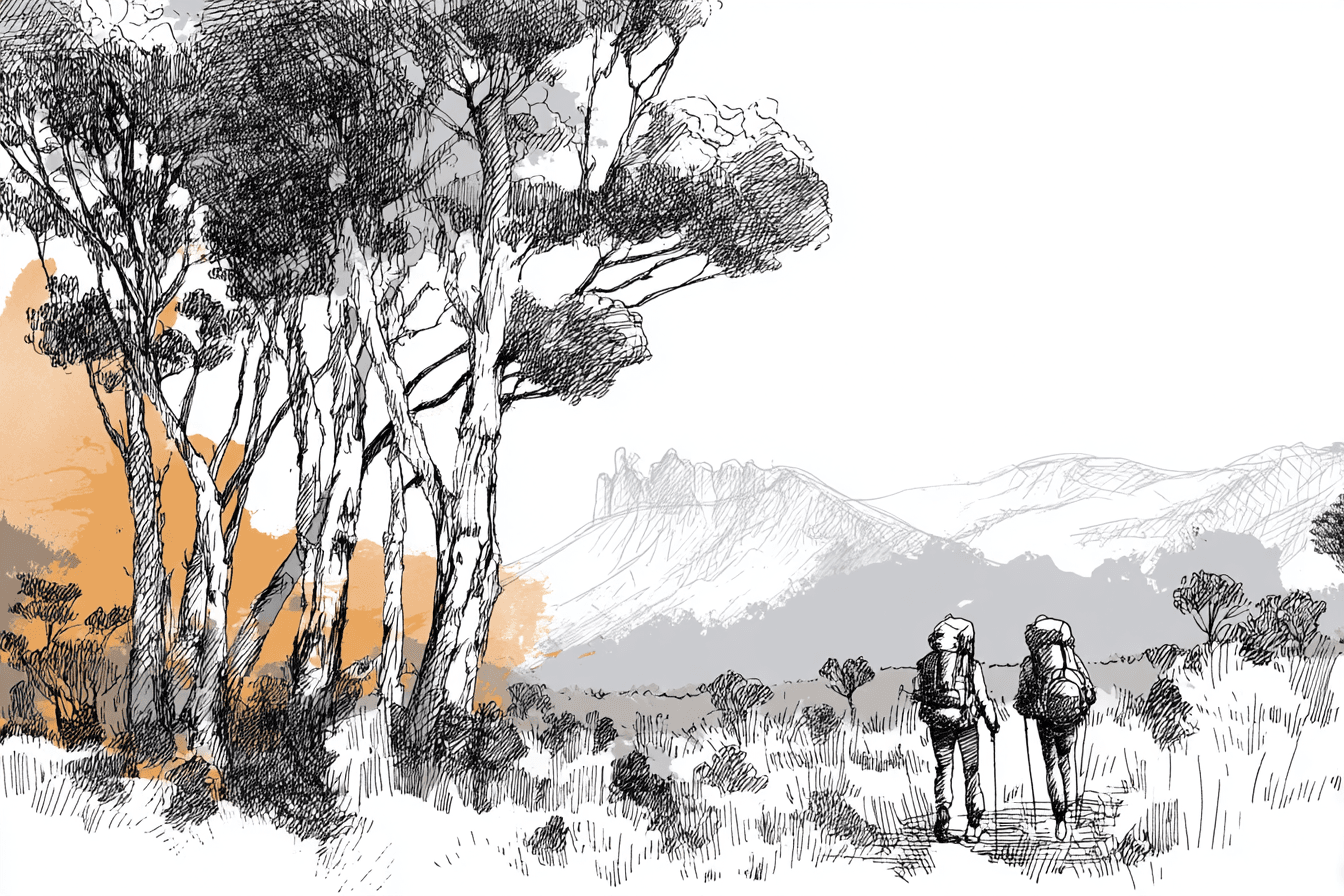
The Overland Track is one of Australia's most celebrated multi-day walks: 65 kilometres through the heart of Tasmania's Wilderness World Heritage Area, from the jagged dolerite columns of Cradle Mountain to the still waters of Lake St Clair. Most walkers take six to eight days, though you can stretch it to ten if you want to tackle the optional side trips to Mount Ossa (Tasmania's highest peak), Barn Bluff, or the Labyrinth.
The terrain is genuinely varied: boardwalks across button-grass moorland, scrambles through boulder fields, descent through ancient myrtle-beech rainforest. You'll cross wide open alpine plateaus that feel like the edge of the world, and squeeze through muddy sections flanked by horizontal scrub. It earns the "great walk" label.
Permits and the booking situation
During the booking season (October to May), a permit is mandatory and Parks Tasmania enforces a daily cap of 34 walkers starting from Ronny Creek. That limit fills fast: popular dates, especially in February and March, can book out within hours of release. The booking system opens around July each year for the following season.
Outside the booking season the track is not closed (you can walk it year-round), but permits are not required and the quota does not apply.
Here's the thing though: the track is rarely actually full. People's plans change. Work happens. Groups lose a member. Someone's knee gives out. Cancellations trickle in constantly. They just disappear in minutes when they do.
If the track looks booked out, it's worth watching. That's what Spotbagger does: we check the Parks Tasmania booking page often and alert you the moment a cancellation appears, so you can grab it before anyone else sees it.
Seasons and conditions
October and November are shoulder months: cooler, wetter, occasionally snowy at altitude, and notably quieter on the track. Worth considering if you don't mind the extra gear weight.
December through February is peak season. Longer daylight hours, better weather odds (though "better" is relative in Tasmania), and the highest chance of fully booked dates. February tends to be the warmest and driest.
March and April are underrated. Fewer walkers, stunning autumn colour in the deciduous beech, still reasonable temperatures. April shoulder prices may apply on accommodation either side of the track.
May is the last month of the booking season. Expect serious cold, shortened days, and the first heavy snowfalls at altitude.
June through September, the track is open but unmanaged and the huts are unstaffed. Snow and ice are common on the alpine sections, extended rain events can last days, and river crossings can become dangerous. This is genuine winter wilderness walking. Only experienced, well-equipped parties should attempt it.
Expect four seasons in a single day regardless of when you go; this is Tasmania. A hard-shell rain jacket is not optional.
Huts and camping
Six main huts are spaced roughly one day's walk apart: Waterfall Valley, Windermere, New Pelion, Old Pelion (day trip from New Pelion), Kia Ora, Bert Nichols, and Echo Point. Each has bunk beds, gas cookers, drop toilets, and emergency communication. No showers.
Tent platforms sit next to most huts for those who prefer to sleep under canvas. Hut bed allocations are part of your permit: you can't turn up and claim a spare bunk.
Gear essentials
The track is well-marked and self-navigating for most walkers, but conditions can turn fast at altitude. The short gear list:
- Rain jacket: hard-shell, not a softshell. Breathable but waterproof.
- Warm layers: fleece or down mid-layer, even in summer
- Waterproof boots: actually waterproof, not just water-resistant
- Sleeping bag: rated to at least 5°C; colder in shoulder months
- Gaiters: near-essential during wet sections
- Navigation: the route is obvious, but carry a map and compass for the side trips
Parks Tasmania publish a detailed gear list; read it before you finalise your pack.
Getting there
The track is point-to-point, so you'll need to sort both ends. Start at Ronny Creek near Cradle Mountain; finish at Cynthia Bay on Lake St Clair. From the track's end at Narcissus Bay you can catch the Lake St Clair ferry across to Cynthia Bay, saving a few flat hours of lakeside walking. You can book it online ahead of your trip.
Shuttle buses connect both trailheads to Launceston, Hobart, and Devonport. Overland Track Transport and Overland Track Shuttle are the main operators; book well in advance, especially in peak season.
Common questions
When do Overland Track bookings open?
The booking system opens around July each year for the following season (October to May). Popular dates, especially in February and March, can book out within hours of release.
The Overland Track is booked out. Can I still get a permit?
Often, yes. Cancellations come back constantly as plans change; they just disappear in minutes when they do. Set up a watch and we'll alert you the moment a place frees up on your start date.
Do I need a permit in winter?
No. Outside the booking season (June to September) permits aren't required and the quota doesn't apply, but the huts are unstaffed and conditions are genuine winter wilderness. Experienced, well-equipped parties only.
Can I walk south to north?
Not in the booking season: permits are for a north-to-south walk, starting at Ronny Creek near Cradle Mountain and finishing at Lake St Clair.
Guides for this track
Can you hike the Overland Track solo?
Thinking about walking Tasmania's Overland Track solo? It is safer and more social than it sounds. Here is how to prepare, and how to still get a spot when the season looks booked.
When do Great Walks and Overland Track bookings open? 2026/27 season dates
Booking-release dates for the Overland Track, NZ Great Walks, Parks Victoria and more, plus what to do when your date sells out in minutes.
Overland Track booked out? How to still get a spot for 2026/27
The Overland Track releases its entire October to May season in a single online queue, and it goes fast. Here is how cancellations still get you on.
Other tracks we watch
Three Capes Track
Tasman National Park, Tasmania, Australia
Milford Track
Fiordland National Park, Southland, New Zealand
Routeburn Track
Mount Aspiring & Fiordland National Parks, Otago & Southland, New Zealand
Kepler Track
Fiordland National Park, Southland, New Zealand
Heaphy Track
Kahurangi National Park, Nelson Tasman & West Coast, New Zealand
Tongariro Northern Circuit
Tongariro National Park, Central North Island, New Zealand
Paparoa Track
Paparoa National Park, West Coast, New Zealand
Rakiura Track
Rakiura National Park, Southland, New Zealand
Whanganui Journey
Whanganui National Park, Manawatū-Whanganui, New Zealand
Abel Tasman Coast Track
Abel Tasman National Park, Nelson Tasman, New Zealand
Hollyford Track
Fiordland National Park, Southland, New Zealand
Frenchmans Cap
Franklin–Gordon Wild Rivers National Park, Tasmania, Australia
Walls of Jerusalem
Walls of Jerusalem National Park, Tasmania, Australia
Federation Peak
Southwest National Park, Tasmania, Australia
Western Arthurs
Southwest National Park, Tasmania, Australia
Mount Anne
Southwest National Park, Tasmania, Australia
Lake Rhona
Franklin–Gordon Wild Rivers National Park, Tasmania, Australia
Eastern Arthurs
Southwest National Park, Tasmania, Australia
Wilsons Prom Southern Circuit
Wilsons Promontory National Park, Victoria, Australia
Wilsons Prom Lightstation
Wilsons Promontory National Park, Victoria, Australia
Can't get a booking?
We'll watch for you.
Spotbagger checks the Overland Track booking page often. The moment a spot opens, we'll tell you.