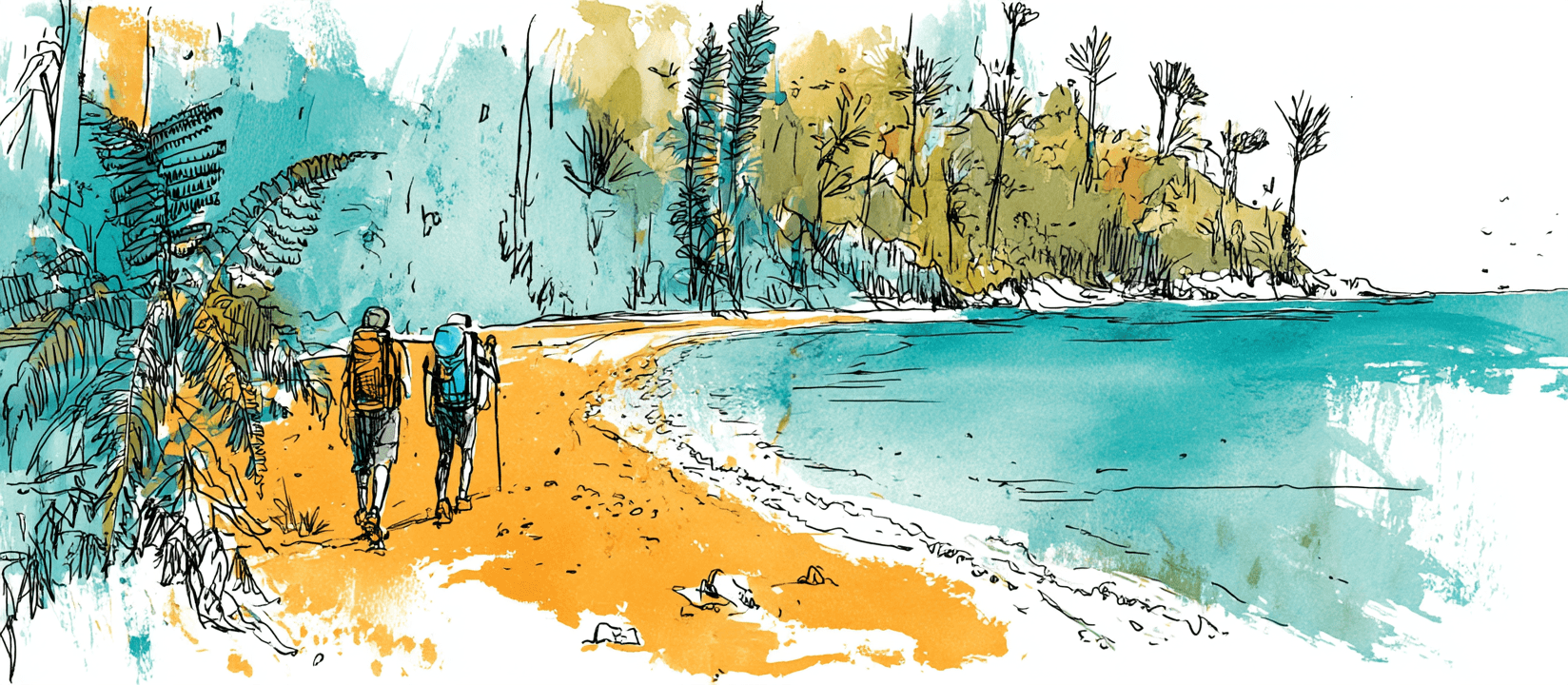
Abel Tasman Coast Track
New Zealand's golden-sand Great Walk, walked hut to hut along a turquoise coast
- Trip style
- Build your own route
- Booking season
- Year-round
- Length
- 60 km one way
- Duration
- 3–5 days
- High point
- ~150 m (coastal)
- Direction
- One way, either end
- Permit
- Mandatory, year-round (DOC)
Track booked out?

You choose your own route and length, booking a spot for each night you need — mix the huts and campsites that fit your plan.
Live availability
Many dates availableOpenings spotted on 50 dates. Next: 24 Oct. Checked in the last hour.
About the track
The Abel Tasman Coast Track is the most golden of New Zealand's Great Walks: 60 kilometres of granite headlands, turquoise bays, and beaches the colour of honey, strung along the seaward edge of Abel Tasman National Park at the top of the South Island. It is the gentlest of the Great Walks underfoot, a well-graded coastal path that rises and falls between one perfect cove and the next, dipping inland through regenerating forest and crossing two tidal estuaries where the timing of your day bends to the sea.
It is a one-way walk through the park, between Mārahau near Motueka in the south and Wainui in the north, and it is walked in either direction. Because water taxis run the length of the coast, almost no two trips look the same: some people walk the whole thing over three or four nights, others get dropped at a far beach and walk back, and many split their nights between the huts and the park's many campsites.
Permits and the booking situation
The Abel Tasman books year-round: every night in a Great Walks hut must be reserved through the DOC booking system before you set off, summer or winter. There are four huts along the coast, from the southern end: Anchorage, Bark Bay, Awaroa, and Whariwharangi. The classic trip strings three or four of them together on consecutive nights, in whichever direction suits your transport. Because the coast is linear, a shorter trip simply skips a hut, and a water taxi can carry you past the gap.
This is the busiest of all the Great Walks, and over summer the huts go fast once bookings open. A single trip needs every chosen night to line up; one full hut blocks the whole date. But the Abel Tasman is rarely actually full. Plans change, groups shrink, someone's water taxi falls through, and bunks trickle back into the system right up to the day before. Because a freed bunk has to line up with the others, a date that has shown "sold out" for months can quietly reopen at any moment.
That is what Spotbagger is for: we check the DOC Great Walks booking page often and search the whole coast both directions, so the instant a complete hut trip opens for your party, on any walkable run of nights, we alert you before anyone else notices.
Seasons and conditions
Unlike the alpine Great Walks, the Abel Tasman has no closed season: the huts are bookable all year, and the mild coastal climate makes a winter walk a genuine, quieter option. The track sits almost at sea level throughout, so it never carries the avalanche or exposure risk of the southern tracks.
The catch here is not altitude but tide. Two crossings, the Awaroa estuary and the inlet at Torrent Bay, are passable only for a few hours either side of low tide, and the Awaroa crossing in particular sets the shape of your walking day. Check the tide tables when you plan your nights, not after; a hut booking that ignores the tide can leave you stranded on the wrong side of an estuary.
December to February are warmest and busiest, with long days and the bays at their swimming best. March and April stay settled and far quieter. Winter brings crisp, calm spells, cool nights, and beaches you may have to yourself, with short days the only real trade-off.
Huts, campsites, and the order of the nights
The four bookable Great Walk huts run south to north: Anchorage Hut, tucked behind a popular swimming beach; Bark Bay Hut, beside a tidal lagoon; Awaroa Hut, just south of the big estuary crossing; and Whariwharangi Hut, a restored historic homestead near the northern end. All have bunk rooms with mattresses, water, and toilets, and no showers, shops, or power. Your booking is the trip: you sleep in the hut you booked on the night you booked it.
The Abel Tasman also has an unusually large network of campsites, many on beaches the huts do not reach, which take separate camping bookings. Plenty of people mix the two. Spotbagger's hut watch covers the four Great Walk huts and the complete trips you can build from them; if you are camping as well, book the campsites directly through DOC.
Gear essentials
The walking is easy and low, but it is still a multi-day coastal trip with sun, sandflies, and tidal crossings. The short list:
- Rain jacket: settled spells are common but the coast still gets soaked by passing fronts
- Warm layer: fleece and a hat year-round; winter nights are cool even at sea level
- Footwear: light boots or sturdy trail shoes; long sandy and gravelled stretches
- Sleeping bag: huts have mattresses only, so bring a bag rated for the season
- Insect repellent: the bays are famous for sandflies; this one is not optional
- Sun protection: the beaches and open headlands give no shade at all
- Tide tables: print the dates of your trip; the Awaroa crossing depends on them
DOC publish a detailed gear list for the Great Walks; read it before you finalise your pack.
Getting there
The southern trailhead, Mārahau, is about an hour by road from Nelson via Motueka, and is where most walks begin. The northern end, Wainui, is a further drive around Golden Bay over the Tākaka Hill. The two ends are far enough apart that few people drive both.
The neat thing about the Abel Tasman is that the sea is the highway: scheduled water taxis run the coast all day, so you can start or finish at almost any beach, skip a section, or send your pack ahead. Most walkers combine a shuttle from Nelson or Motueka with a water taxi at one end. Sort your transport as soon as your hut nights are confirmed; on peak dates the taxis fill nearly as fast as the bunks.
Common questions
Do I need to book the Abel Tasman in winter?
Yes. The huts book year-round: every Great Walks hut night must be reserved through DOC before you set off, whatever the season.
The huts are booked out. Can I still get a spot?
Often, yes. Bunks trickle back into the system right up to the day before, and a single freed bunk can reopen a date because every hut on your trip has to line up. Set up a watch and we'll alert you the moment a complete trip opens for your party, in either direction.
Can I walk it in either direction?
Yes. The coast is walked both from Mārahau in the south and from Wainui in the north, and water taxis make either start easy. Spotbagger searches both directions, so you see whichever way opens up first.
How many days do I need?
Most walkers take three or four days, with nights spread between Anchorage, Bark Bay, Awaroa, and Whariwharangi. A water taxi can shorten the walking while still linking the huts you have booked.
Guides for this track
When do Great Walks and Overland Track bookings open? 2026/27 season dates
Booking-release dates for the Overland Track, NZ Great Walks, Parks Victoria and more, plus what to do when your date sells out in minutes.
NZ Great Walks sold out? How to still get a hut for the 2026/27 season
The popular NZ Great Walks book out the morning they open. Here is why, which ones go fastest, and how to still land a hut through cancellations.
Other tracks we watch
Overland Track
Cradle Mountain–Lake St Clair National Park, Tasmania, Australia
Three Capes Track
Tasman National Park, Tasmania, Australia
Milford Track
Fiordland National Park, Southland, New Zealand
Routeburn Track
Mount Aspiring & Fiordland National Parks, Otago & Southland, New Zealand
Kepler Track
Fiordland National Park, Southland, New Zealand
Heaphy Track
Kahurangi National Park, Nelson Tasman & West Coast, New Zealand
Tongariro Northern Circuit
Tongariro National Park, Central North Island, New Zealand
Paparoa Track
Paparoa National Park, West Coast, New Zealand
Rakiura Track
Rakiura National Park, Southland, New Zealand
Whanganui Journey
Whanganui National Park, Manawatū-Whanganui, New Zealand
Hollyford Track
Fiordland National Park, Southland, New Zealand
Frenchmans Cap
Franklin–Gordon Wild Rivers National Park, Tasmania, Australia
Walls of Jerusalem
Walls of Jerusalem National Park, Tasmania, Australia
Federation Peak
Southwest National Park, Tasmania, Australia
Western Arthurs
Southwest National Park, Tasmania, Australia
Mount Anne
Southwest National Park, Tasmania, Australia
Lake Rhona
Franklin–Gordon Wild Rivers National Park, Tasmania, Australia
Eastern Arthurs
Southwest National Park, Tasmania, Australia
Wilsons Prom Southern Circuit
Wilsons Promontory National Park, Victoria, Australia
Wilsons Prom Lightstation
Wilsons Promontory National Park, Victoria, Australia
Can't get a booking?
We'll watch for you.
Spotbagger checks the Abel Tasman Coast Track booking page often. The moment a spot opens, we'll tell you.