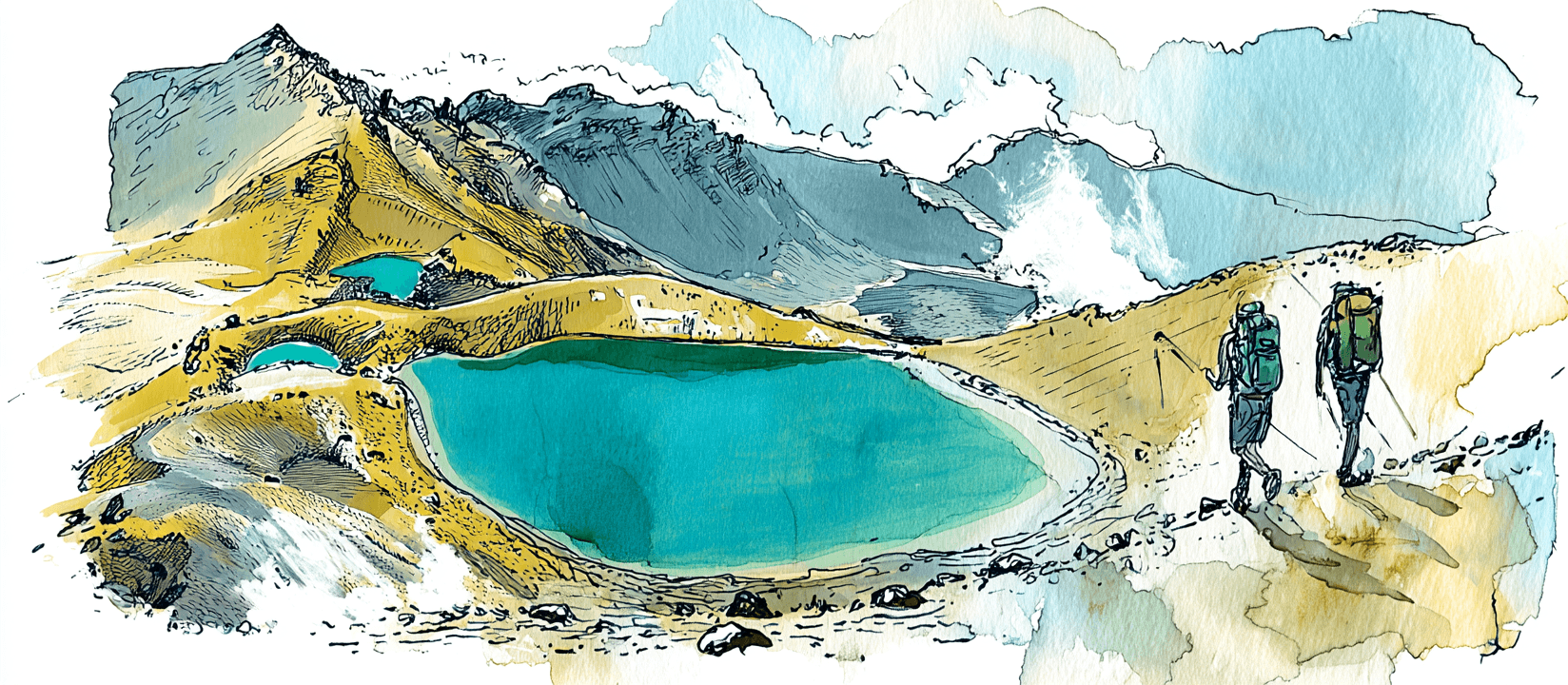
Tongariro Northern Circuit
The volcanic Great Walk around Mt Ngauruhoe
- Trip style
- Fixed itinerary
- Booking season
- Late Oct – Late Apr
- Length
- 43 km loop
- Duration
- 3–4 days / 3 nights
- High point
- ~1,868 m (Red Crater)
- Direction
- Loop, either way
- Permit
- Mandatory in season (DOC)
Track booked out?

Live availability
Many dates availableOpenings spotted on 64 dates. Next: 9 Nov. Checked 4 hours ago.
About the track
The Tongariro Northern Circuit is the volcanic Great Walk: 43 kilometres looping around Mt Ngauruhoe through the heart of Tongariro National Park, New Zealand's oldest national park and a dual World Heritage site. It is a landscape unlike anything else on the Great Walks list, a place of old lava flows, steaming craters, glassy alpine lakes, and a near-perfect volcanic cone that doubled as Mount Doom on screen.
Its most famous day shares ground with the Tongariro Alpine Crossing, climbing past the Emerald Lakes and over the Red Crater at around 1,868 metres before the loop turns south and east through the quieter Oturere Valley and beech forest back to Whakapapa. On a clear day it is one of the most striking walks in the country. In bad weather it is exposed, alpine, active volcanic country with very little shelter, which is exactly why the booking and the forecast both matter.
Permits and the booking situation
In the Great Walks season (late October to late April) the Northern Circuit is a booked, hut-based walk. The standard trip is three nights, one each at Mangatepopo Hut, Oturere Hut, and Waihōhonu Hut, and because it's a loop you can walk it in either direction. DOC's recommended direction is clockwise, reaching Mangatepopo first and crossing the Red Crater on your second day, but plenty of walkers do it the other way around. Either way, you book a bunk for each night of your trip.
When bookings open (usually around the middle of the year for the coming season), the best summer dates go quickly. This is one of the more popular Great Walks, helped by its proximity to the famous day crossing, and a good weekend can show every hut full months out. A single date needs all three huts to line up on consecutive nights.
Here's the thing though: the track is rarely actually full. People's plans change. Flights fall through. Groups lose a member, or the volcanic-alpine forecast turns and someone gets cold feet. Cancellations trickle back into the system constantly. And because a full trip needs all three huts on consecutive nights, a single freed bunk can quietly reopen a date that was "sold out" for months.
If the track looks booked out, it's worth watching. That's what Spotbagger does: we check the DOC Great Walks booking page often and alert you the moment a full three-night trip opens up for your party (in either direction), so you can grab it before anyone else sees it.
Seasons and conditions
The Great Walks season runs from late October to late April, when the huts are staffed and the track is managed for less-experienced walkers. Outside those dates the circuit becomes a serious alpine mountaineering trip: snowbound, ice-axe-and-crampons terrain, and not recommended for most.
Even in summer the weather here is the real hazard. The plateau sits high and fully exposed, and conditions change fast: it can be warm and still at the trailhead and a cold, wind-driven white-out on the Red Crater an hour later. Snow, hail, and freezing wind are possible in any month, and hypothermia, not the volcano, is the most common reason walkers get into trouble up top. This is also an active volcanic zone, so check DOC and GeoNet for current volcanic alert levels before you go, and know your nearest exit if conditions turn.
November and December bring long days and lingering snow up high early in the season. January and February are the warmest and busiest. March and April are quieter and atmospheric, with crisp mornings and shorter, colder days. Whenever you go, treat the tops with respect and carry layers for weather you can't see coming. A genuine waterproof rain jacket and warm layers are the single most important things in your pack.
Huts (and the order of the nights)
There are three Great Walks huts, and on a three-night trip you stay one night at each. Walking clockwise that's Mangatepopo Hut (night one, near the start of the alpine crossing section), Oturere Hut (night two, out on the eastern lava fields below the Red Crater), and Waihōhonu Hut (night three, a large modern hut in beech forest). Walk it the other way and you stay in the reverse order. Each hut has bunk rooms with mattresses, gas cookers, cold running water, and toilets, but no showers, no shops, and no power.
Your bunks are part of your booking, and the booking is the trip: you can't turn up and claim a spare mattress, and you can't skip ahead a hut. There are campsites at the huts for those with a separate camping booking, but the classic Northern Circuit is walked hut to hut.
Gear essentials
The track is well-formed and well-marked, but the exposed volcanic tops do the testing, and the right gear for bad weather is what keeps the walk safe rather than serious. The short list:
- Rain jacket: a proper hard-shell, fully waterproof, not water-resistant, with a hood that seals
- Waterproof overtrousers: the wind-driven rain up high gets in everywhere a jacket alone won't stop
- Warm layers: fleece or down mid-layer plus a warm hat and gloves, packed even in midsummer, for the exposed crater section
- Sturdy boots: broken-in, with good tread for loose scoria, wet rock, and the steep descent off the Red Crater
- Sleeping bag: the huts have mattresses but no bedding; bring a bag rated to at least 5°C
- Quick-dry clothing: cotton stays wet and cold; merino or synthetic layers dry and keep warmth when damp
- Sun and wind protection: the plateau is fully exposed, so bring sunglasses, sunscreen, and a brimmed hat
DOC publish a detailed gear list for the Great Walks, and the Tongariro alpine conditions make it worth following to the letter. Carry enough warm, waterproof gear to sit out a sudden change in the weather, not just to keep moving through it.
Getting there
The loop starts and finishes at Whakapapa Village on the western side of the park, about a four to five hour drive from Auckland or Wellington and close to the Tongariro National Park and National Park Village settlements. There's parking at Whakapapa, and shuttle operators serve the village and the nearby trailheads through the season.
Because the day crossing and the Northern Circuit share their most famous stretch, the area is well set up for walkers: transport, lodging, and gear hire are all easy to arrange in the surrounding villages. That's worth locking in once your hut nights are confirmed, especially for peak-season dates.
Common questions
When do Tongariro Northern Circuit bookings open?
DOC usually opens bookings for the coming season around the middle of the year. This is one of the busier Great Walks, helped by its proximity to the Tongariro Alpine Crossing, so the best summer dates still go quickly.
The Tongariro huts are full. Can I still get a spot?
Often, yes. Cancellations trickle back constantly, and because a trip needs all three huts on consecutive nights, one freed bunk can reopen a date that's looked sold out for months. Set up a watch and we'll alert you the moment a full loop opens for your party.
Which direction should I walk the loop?
Either way works, and a Spotbagger watch checks both. DOC recommends clockwise, putting the climb over the Red Crater on your second day, but walkers who want that big day earlier or later happily go the other way. Whichever you choose, plan to cross the high, exposed section in the best weather window you can get.
Guides for this track
When do Great Walks and Overland Track bookings open? 2026/27 season dates
Booking-release dates for the Overland Track, NZ Great Walks, Parks Victoria and more, plus what to do when your date sells out in minutes.
NZ Great Walks sold out? How to still get a hut for the 2026/27 season
The popular NZ Great Walks book out the morning they open. Here is why, which ones go fastest, and how to still land a hut through cancellations.
Other tracks we watch
Overland Track
Cradle Mountain–Lake St Clair National Park, Tasmania, Australia
Three Capes Track
Tasman National Park, Tasmania, Australia
Milford Track
Fiordland National Park, Southland, New Zealand
Routeburn Track
Mount Aspiring & Fiordland National Parks, Otago & Southland, New Zealand
Kepler Track
Fiordland National Park, Southland, New Zealand
Heaphy Track
Kahurangi National Park, Nelson Tasman & West Coast, New Zealand
Paparoa Track
Paparoa National Park, West Coast, New Zealand
Rakiura Track
Rakiura National Park, Southland, New Zealand
Whanganui Journey
Whanganui National Park, Manawatū-Whanganui, New Zealand
Abel Tasman Coast Track
Abel Tasman National Park, Nelson Tasman, New Zealand
Hollyford Track
Fiordland National Park, Southland, New Zealand
Frenchmans Cap
Franklin–Gordon Wild Rivers National Park, Tasmania, Australia
Walls of Jerusalem
Walls of Jerusalem National Park, Tasmania, Australia
Federation Peak
Southwest National Park, Tasmania, Australia
Western Arthurs
Southwest National Park, Tasmania, Australia
Mount Anne
Southwest National Park, Tasmania, Australia
Lake Rhona
Franklin–Gordon Wild Rivers National Park, Tasmania, Australia
Eastern Arthurs
Southwest National Park, Tasmania, Australia
Wilsons Prom Southern Circuit
Wilsons Promontory National Park, Victoria, Australia
Wilsons Prom Lightstation
Wilsons Promontory National Park, Victoria, Australia
Can't get a booking?
We'll watch for you.
Spotbagger checks the Tongariro Northern Circuit booking page often. The moment a spot opens, we'll tell you.